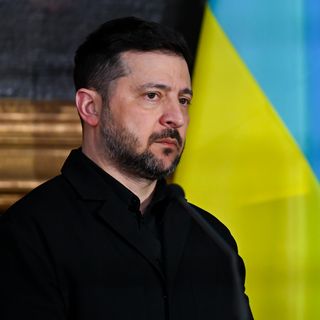
Zelensky says Ukrainian public won't let him hand Russia territory
By Barak Ravid
Transparency Analysis
Primary Narrative
Ukrainian President Zelensky warns that the Ukrainian public will reject any peace deal requiring unilateral territorial concessions to Russia, while expressing skepticism about U.S. pressure tactics and openness to freezing current battle lines.
⚠ Conflicts of Interest
Axios reporter Barak Ravid conducted exclusive 37-minute interview with Zelensky, giving Axios first access to frame his negotiating position and concerns about Trump's tactics
Evidence: Article states 'In his 37-minute phone interview with Axios, Zelensky noted...' and multiple direct quotes throughout
Who Benefits?
Volodymyr Zelensky
Article presents his negotiating position and domestic political constraints sympathetically, portraying him as constrained by democratic will rather than obstinate
Ukrainian government
Framing emphasizes Ukrainian public opinion as legitimate constraint on negotiations, strengthening Zelensky's negotiating position internationally
Framing Analysis
Perspective
Zelensky's viewpoint is centered throughout; article presents his concerns, constraints, and negotiating positions as primary narrative
Tone
Language Choices
- Zelensky 'made clear he's much more pessimistic' - frames his skepticism as justified realism
- 'not fair' that Trump pressures Ukraine - uses Zelensky's characterization without independent analysis
- 'Emotionally, people will never forgive this' - emotionally charged language attributed to Zelensky
- 'Friction point' as subheading - frames Trump-Zelensky disagreement as notable tension
Omitted Perspectives
- Russian negotiating position or rationale (beyond brief mention that Russia insists on full Donbas)
- Trump administration's full reasoning for public pressure strategy
- Detailed explanation of why U.S. mediators believe Russia genuinely wants to end war
- Perspective of Donbas residents on territorial arrangements
Entity Relationships
Witkoff is identified as U.S. mediator in negotiations | Evidence: U.S. mediators Steve Witkoff and Jared Kushner
Kushner is identified as U.S. mediator in negotiations | Evidence: U.S. mediators Steve Witkoff and Jared Kushner
Medinsky is identified as Putin adviser and new leader of Russian delegation | Evidence: Putin adviser Vladimir Medinsky
Factual Core
Ukrainian and Russian negotiators held third round of direct talks in Geneva with territorial control of Donbas as primary dispute. Zelensky stated in interview that Ukrainian public would reject territorial concessions but might accept freezing current battle lines, while expressing skepticism about Trump administration's negotiating approach.
Full Article
The Ukrainian people would reject a peace deal that involves Ukraine unilaterally withdrawing from the eastern Donbas region and turning it over to Russia, President Volodymyr Zelensky told Axios in an interview Tuesday. Why it matters: As Zelensky was speaking to Axios, Ukrainian and Russian negotiators were meeting for a third round of direct talks in Geneva. The main sticking point is control of the Donbas, around 10% of which is still in Ukrainian hands. Zelensky said U.S. mediators Steve Witkoff and Jared Kushner have told him Russia genuinely wants to end the war, and that he should coordinate with his own negotiating team on that basis ahead of the talks. But Zelensky made clear he's much more pessimistic. He also advised Witkoff and Kushner that they shouldn't try to force him to sell a vision of peace his own people would see as an "unsuccessful story." Friction point: Zelensky said it was "not fair" that President Trump kept publicly calling on Ukraine, not Russia, to make concessions for peace. He contended that, while it might be easier for Trump to pressure Ukraine than the much larger Russia, the way to create a lasting peace is not "to give victory" to Russian President Vladimir Putin. Trump said twice in recent days that the onus was on Zelensky to make concessions. "I hope it is just his tactics and not the decision," Zelensky told Axios. He also thanked Trump for his peacemaking efforts, and said his conversations with Kushner and Witkoff don't involve the kind of pressure Trump uses in public. "We respect each other," he said, adding that he was "not such a person" who folds easily under pressure. Data: ISW/CTP; Map: Axios Visuals Zelensky reiterated that the best way to find a breakthrough on territory is for Putin to meet him face to face. He said he'd told his team to raise a future leader-level meeting in Geneva. Driving the news: The U.S. mediators have proposed that Ukrainian forces withdraw from the parts of the Donbas they currently hold and allow that area to become a demilitarized "free economic zone." Washington has not taken a position on which country would hold sovereignty there. Zelensky is prepared to discuss a troop withdrawal, but has called for Moscow to pull its troops back an equivalent distance — and has rejected Russia's claim to sovereignty over the zone. Zelensky claimed that in the second round of talks, Russian officials promised to consult with Moscow and return with a detailed position on the territorial question. What he's saying: In his 37-minute phone interview with Axios, Zelensky noted that Washington and Kyiv have agreed that any deal must be put to the Ukrainian people in a referendum. If that deal involves the Ukrainian side simply pulling out of Donbas — sacrificing sovereignty and the citizenship of the people who live there — he believes it would be voted down. "Emotionally, people will never forgive this. Never. They will not forgive... me, they will not forgive [the U.S.]," Zelensky said, adding that Ukrainians "can't understand why" they would be asked to give up additional land. "This is part of our country, all these citizens, the flag, the land," Zelensky said. The flipside: If the deal simply freezes the current battle lines in the Donbas, as is the plan in two other regions where Russia holds territory, Zelensky thinks the Ukrainian people would accept it. "I think that if we will put in the document ... that we stay where we stay on the contact line, I think that people will support this [in a] referendum. That is my opinion." But Russia insists it will take the full Donbas either through talks or by force. Addressing the dispute in a way that both sides can accept is the primary focus for Witkoff and Kushner in this week's talks. The intrigue: The Russian delegation has a new leader: Putin adviser Vladimir Medinsky. Given the change in leadership, Zelensky worries the Russian delegation will try to turn the talks into a meet and greet, or return to square one to buy more time for Russia on the battlefield. He also noted that, like Putin, Medinsky likes to philosophize about the "historical roots" of the war. "We don't have time for all this shit. So we have to decide, and have to finish the war," Zelensky said. State of play: While the political dialogue has been slow-going, Zelensky said military-to-military talks with Russia in Abu Dhabi were more productive. The sides largely agreed on a U.S.-led mechanism to monitor a ceasefire using drones, should one be reached, he said. But while Ukraine also wants European countries involved, the Russians are opposed. What to watch: Zelensky said nothing is settled, but it's possible new presidential elections will be held alongside a referendum. Zelensky told Axios in September that once the war was over, he would step away from politics. But in Tuesday's interview, he suggested that any election may have to take place during a fragile ceasefire, and that he may be a candidate in such a scenario. "It will depend on the people. We will see what they want." He also noted that, for now, Russia has only agreed on a one-day ceasefire for Ukraine to organize and hold a national vote, rather than the 60 days Zelensky thinks are needed. He saw the Russian position as absurd, and a possible indication that Moscow is not prepared for genuine peace. What's next: Trilateral talks in Geneva are expected to continue on Wednesday.